-
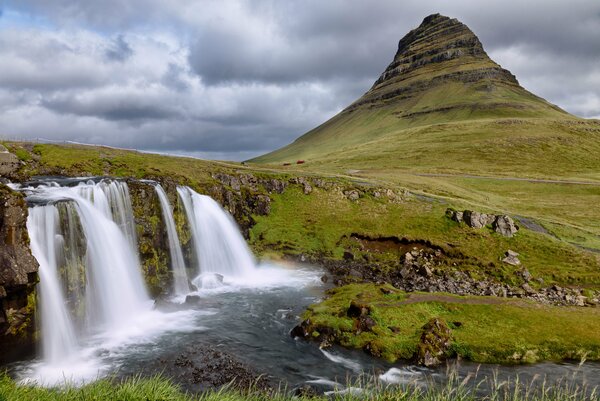
Iceland
Arcadia, P&O Cruises
BOOK WITH CONFIDENCE
Family run business established in 1983. ABTA & ATOL Protected.
COMPETITIVELY PRICED
We work closely with our travel partners to secure the best holiday price available.
KNOWLEDGE & SERVICE
Our extensively travelled team are here to ensure you receive the very best advice and first-class service.
Arcadia
Departure: 05/08/2026
Duration: 17 Days
Roundtrip from Southampton
Itinerary
Iceland
-
Day 1 Southampton, England 05 Aug 2026 (Wednesday)
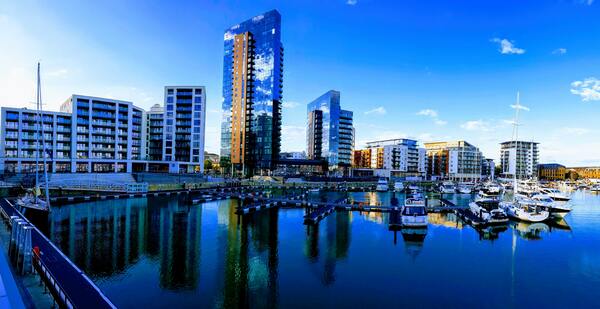
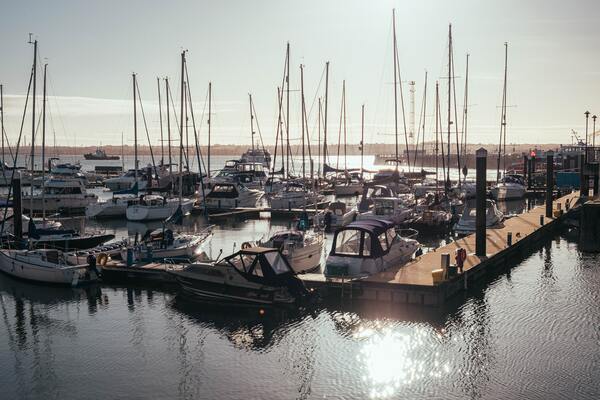
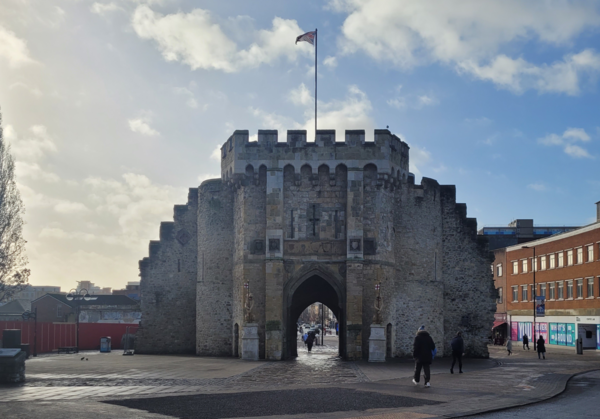
Lying near the head of Southampton Water, a peninsula between the estuaries of the Rivers Test and Itchen, Southampton is Britain’s largest cruise port. It has been one of England’s major ports since the Middle Ages, when it exported wool and hides from the hinterland and imported wine from Bordeaux. The city suffered heavy damage during World War Two and as a result the centre has been extensively rebuilt, but there are still some interesting medieval buildings including the Bargate, one of the finest city gatehouses in England.
-
Day 5 Reykjavík, Iceland 09 Aug 2026 (Sunday)
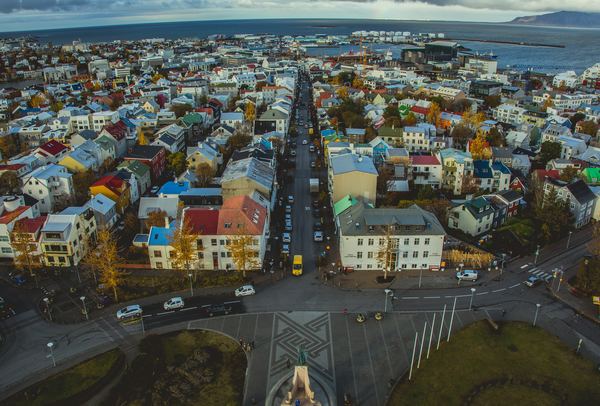
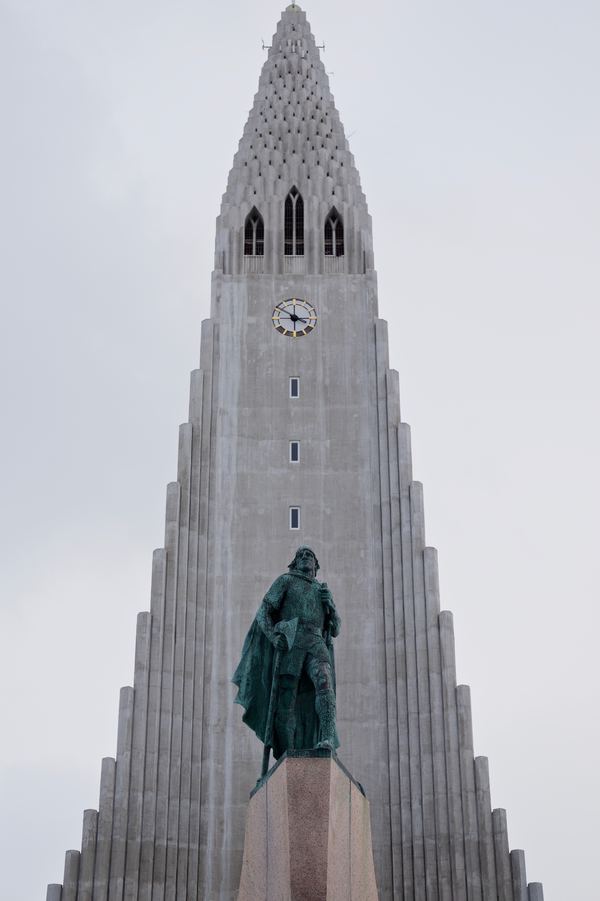
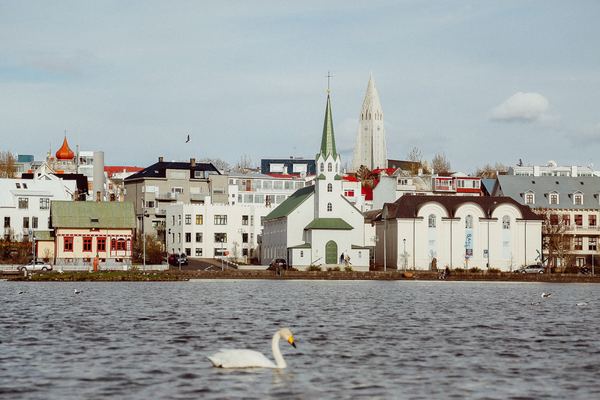
Sprawling Reykjavík, the nation's nerve center and government seat, is home to half the island's population. On a bay overlooked by proud Mt. Esja (pronounced eh-shyuh), with its ever-changing hues, Reykjavík presents a colorful sight, its concrete houses painted in light colors and topped by vibrant red, blue, and green roofs. In contrast to the almost treeless countryside, Reykjavík has many tall, native birches, rowans, and willows, as well as imported aspen, pines, and spruces.Reykjavík's name comes from the Icelandic words for smoke, reykur, and bay, vík. In AD 874, Norseman Ingólfur Arna... See moreSprawling Reykjavík, the nation's nerve center and government seat, is home to half the island's population. On a bay overlooked by proud Mt. Esja (pronounced eh-shyuh), with its ever-changing hues, Reykjavík presents a colorful sight, its concrete houses painted in light colors and topped by vibrant red, blue, and green roofs. In contrast to the almost treeless countryside, Reykjavík has many tall, native birches, rowans, and willows, as well as imported aspen, pines, and spruces.Reykjavík's name comes from the Icelandic words for smoke, reykur, and bay, vík. In AD 874, Norseman Ingólfur Arnarson saw Iceland rising out of the misty sea and came ashore at a bay eerily shrouded with plumes of steam from nearby hot springs. Today most of the houses in Reykjavík are heated by near-boiling water from the hot springs. Natural heating avoids air pollution; there's no smoke around. You may notice, however, that the hot water brings a slight sulfur smell to the bathroom.Prices are easily on a par with other major European cities. A practical option is to purchase a Reykjavík City Card at the Tourist Information Center or at the Reykjavík Youth Hostel. This card permits unlimited bus usage and admission to any of the city's seven pools, the Family Park and Zoo, and city museums. The cards are valid for one (ISK 3,300), two (ISK 4,400), or three days (ISK 4,900), and they pay for themselves after three or four uses a day. Even lacking the City Card, paying admission (ISK 500, or ISK 250 for seniors and people with disabilities) to one of the city art museums (Hafnarhús, Kjarvalsstaðir, or Ásmundarsafn) gets you free same-day admission to the other two.
See less -
Day 6 Reykjavík, Iceland 10 Aug 2026 (Monday)
Sprawling Reykjavík, the nation's nerve center and government seat, is home to half the island's population. On a bay overlooked by proud Mt. Esja (pronounced eh-shyuh), with its ever-changing hues, Reykjavík presents a colorful sight, its concrete houses painted in light colors and topped by vibrant red, blue, and green roofs. In contrast to the almost treeless countryside, Reykjavík has many tall, native birches, rowans, and willows, as well as imported aspen, pines, and spruces.Reykjavík's name comes from the Icelandic words for smoke, reykur, and bay, vík. In AD 874, Norseman Ingólfur Arna... See moreSprawling Reykjavík, the nation's nerve center and government seat, is home to half the island's population. On a bay overlooked by proud Mt. Esja (pronounced eh-shyuh), with its ever-changing hues, Reykjavík presents a colorful sight, its concrete houses painted in light colors and topped by vibrant red, blue, and green roofs. In contrast to the almost treeless countryside, Reykjavík has many tall, native birches, rowans, and willows, as well as imported aspen, pines, and spruces.Reykjavík's name comes from the Icelandic words for smoke, reykur, and bay, vík. In AD 874, Norseman Ingólfur Arnarson saw Iceland rising out of the misty sea and came ashore at a bay eerily shrouded with plumes of steam from nearby hot springs. Today most of the houses in Reykjavík are heated by near-boiling water from the hot springs. Natural heating avoids air pollution; there's no smoke around. You may notice, however, that the hot water brings a slight sulfur smell to the bathroom.Prices are easily on a par with other major European cities. A practical option is to purchase a Reykjavík City Card at the Tourist Information Center or at the Reykjavík Youth Hostel. This card permits unlimited bus usage and admission to any of the city's seven pools, the Family Park and Zoo, and city museums. The cards are valid for one (ISK 3,300), two (ISK 4,400), or three days (ISK 4,900), and they pay for themselves after three or four uses a day. Even lacking the City Card, paying admission (ISK 500, or ISK 250 for seniors and people with disabilities) to one of the city art museums (Hafnarhús, Kjarvalsstaðir, or Ásmundarsafn) gets you free same-day admission to the other two.
See less - Day 7 Grundarfjørdur, Iceland 11 Aug 2026 (Tuesday)
-
Day 8 Isafjørdur, Iceland 12 Aug 2026 (Wednesday)
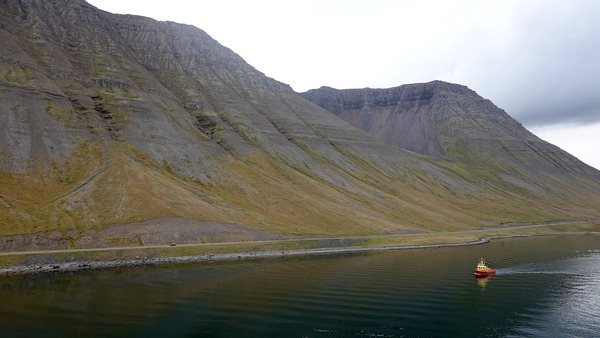
Two colossal terraces of sheer rock stand either side of this extraordinarily located town - which rides a jutting spit onto an immensity of black fjord water. Surprisingly, considering the remoteness of its location and its compact size, Isafjordur is a modern and lively place to visit, offering a great choice of cafes and delicious restaurants – which are well stocked to impress visitors. The town is a perfectly located base for adventures amongst Iceland's fantastic wilderness - with skiing, hiking and water-sports popular pursuits among visitors.Two colossal terraces of sheer rock stand either side of this extraordinarily located town - which rides a jutting spit onto an immensity of black fjord water. Surprisingly, considering the remoteness of its location and its compact size, Isafjordur is a modern and lively place to visit, offering a great choice of cafes and delicious restaurants – which are well stocked to impress visitors. The town is a perfectly located base for adventures amongst Iceland's fantastic wilderness - with skiing, hiking and water-sports popular pursuits among visitors.
See less -
Day 9 Akureyri, Iceland 13 Aug 2026 (Thursday)
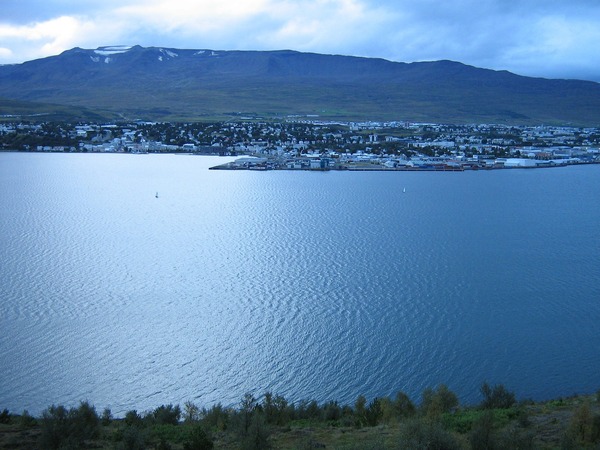
Akureyri, called the Capital of the North is the second largest urban area in Iceland, and a lively one at that. Hemmed by the 60-km (37-mile) long Eyjafjörður, Akureyri is sheltered from the ocean winds and embraced by mountains on three sides. Late 19th-century wooden houses impart a sense of history, and the twin spires of a modern Lutheran church rising on a green hill near the waterfront, provide a focal point. To the south of Akureyri is the pyramid-shape rhyolite mountain Súlur. Beyond it is Kerling, the highest peak in Eyjafjörður District.Akureyri, called the Capital of the North is the second largest urban area in Iceland, and a lively one at that. Hemmed by the 60-km (37-mile) long Eyjafjörður, Akureyri is sheltered from the ocean winds and embraced by mountains on three sides. Late 19th-century wooden houses impart a sense of history, and the twin spires of a modern Lutheran church rising on a green hill near the waterfront, provide a focal point. To the south of Akureyri is the pyramid-shape rhyolite mountain Súlur. Beyond it is Kerling, the highest peak in Eyjafjörður District.
See less -
Day 11 Stornoway, Isle of Lewis, Scotland 15 Aug 2026 (Saturday)
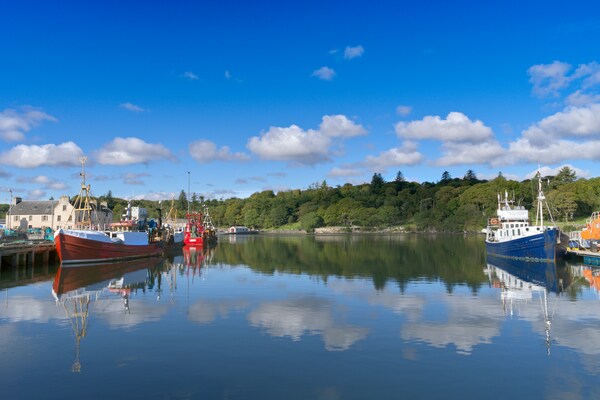
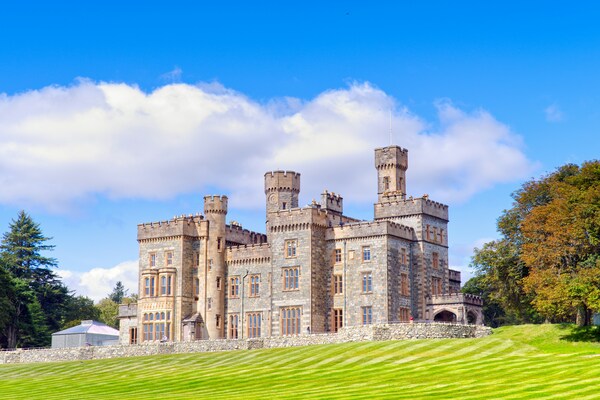
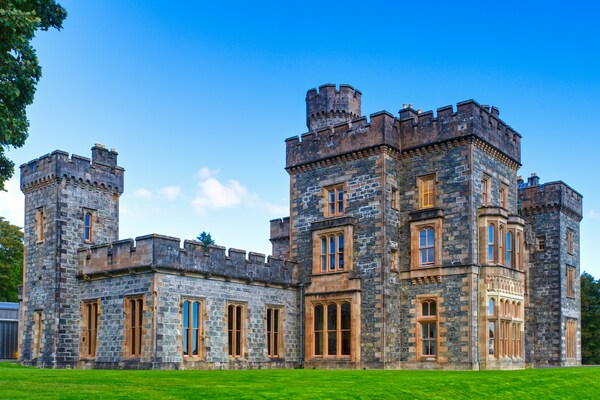
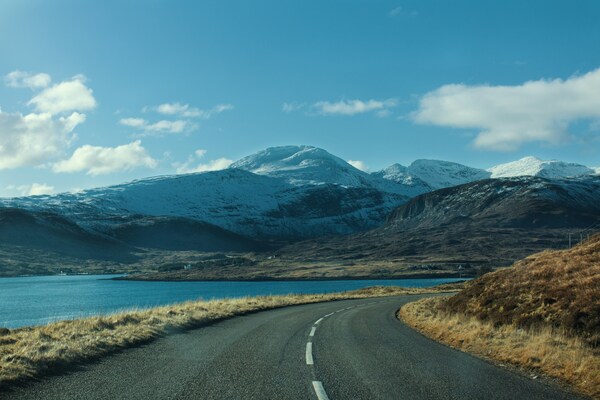
Tour description Stornoway, Scotland The Isle of Lewis and Harris is the northernmost and largest of the Outer Hebrides-the Western Isles in common parlance. The island's only major town, Stornoway, is on a nearly landlocked harbor on the east coast of Lewis. It's the port capital for the Outer Hebrides and the island's cultural center, such that it is. Stornoway has an increasing number of good restaurants. Lewis has some fine historic attractions, including the Calanais Standing Stones-a truly magical place. The Uists are known for their rare, plentiful wildlife. Stornoway. Besides being the... See moreTour description Stornoway, Scotland The Isle of Lewis and Harris is the northernmost and largest of the Outer Hebrides-the Western Isles in common parlance. The island's only major town, Stornoway, is on a nearly landlocked harbor on the east coast of Lewis. It's the port capital for the Outer Hebrides and the island's cultural center, such that it is. Stornoway has an increasing number of good restaurants. Lewis has some fine historic attractions, including the Calanais Standing Stones-a truly magical place. The Uists are known for their rare, plentiful wildlife. Stornoway. Besides being the island's main entry point for ferries, Stornoway is also Lewis's main arts center. You'll find some good restaurants in town if you want to have lunch off the ship. The town can be explored by bicycle if you are so inclined. Local rental shops can give you advice on where to ride, including a route to Tolsta that takes in five stunning beaches before reaching the edge of moorland. An Lanntair Arts Centre. The fabulous An Lanntair Arts Centre has exhibitions of contemporary and traditional art, as well as a cinema, a gift shop, and a restaurant serving international and Scottish fare. There are frequent traditional musical and theatrical events in the impressive auditorium. Kenneth St.. Black House. In the small community of Arnol, the Black House is a well-preserved example of an increasingly rare type of traditional Hebridean home. Once common throughout the islands-even into the 1950s-these dwellings were built without mortar and thatched on a timber framework without eaves. Other characteristic features include an open central peat hearth and the absence of a chimney-hence the soot and the designation black. On display inside are many of the house's original furnishings. To reach Arnol from Port of Ness, head south on the A857 and pick up the A858 at Barvas. Off A858, 21 mi southwest of Port of Ness. Admission charged. Calanais Standing Stones. These impressive stones are actually part of a cluster of several different archaeological sites in this area. Probably positioned in several stages between 3000 BC and 1500 BC, the grouping consists of an avenue of 19 monoliths extending northward from a circle of 13 stones, with other rows leading south, east, and west. Ruins of a cairn sit within the circle on the east side. Researchers believe they may have been used for astronomical observations, but you can create your own explanations. The visitor center has an exhibit on the stones, a gift shop, and a tearoom. On an unmarked road off A858. Admission charged. Dun Carloway. One of the best-preserved Iron Age brochs (circular stone towers) in Scotland, Dun Carloway dominates the scattered community of Carloway. The mysterious tower was probably built around 2,000 years ago as protection against seaborne raiders. The Dun Broch Centre explains more about the broch and its setting. Off A857. Gearrannan. Up a side road north from Carloway, Gearrannan is an old black-house village that has been brought back to life with a museum screening excellent short films on peat cutting and weaving. For a unique experience, groups can rent the restored houses. Leverburgh. At Leverburgh you can take the ferry to North Uist. Nearby Northton has several attractions; St. Clement's Church at Rodel is particularly worth a visit. MacGillivray Centre. Located in a round building overlooking the bay, the MacGillivray Centre gives insight into the life and work of William MacGillivray (1796-1852), a noted naturalist with strong links to Harris. MacGillivray authored the five-volume History of British Birds. This is a great location for a picnic (there are tables for just such a purpose). A walk to a ruined church starts at the parking lot. A859, Northton. Seallam! Visitor Centre and Co Leis Thu? Genealogical Research Centre. The center is where you can trace your Western Isles ancestry. Photographs and interpretive signs describe the history of Harris and its people. The owners organize guided walks and cultural evenings weekly between May and September. Off A859, Northton. Admission charged. St. Clement's Church. At the southernmost point of Harris is the community of Rodel, where you can find St. Clement's Church, a cruciform church standing on a hillock. This is the most impressive pre-Reformation church in the Outer Hebrides; it was built around 1500 and contains the magnificently sculptured tomb (1528) of the church's builder, Alasdair Crotach, MacLeod chief of Dunvegan Castle. Rodel is 3 mi south of Leverburgh and 21 mi south of Tarbert. A859, Rodel. Port of Ness. The stark, windswept community of Port of Ness, 30 mi north of Stornoway, cradles a small harbor squeezed in among the rocks. Butt of Lewis Lighthouse. At the northernmost point of Lewis stands the Butt of Lewis Lighthouse, designed by David and Thomas Stevenson (of the prominent engineering family whose best-known member was not an engineer at all, but the novelist Robert Louis Stevenson). The structure was first lighted in 1862. The adjacent cliffs provide a good vantage point for viewing seabirds, whales, and porpoises. The lighthouse is northwest of Port of Ness along the B8014. Shopping Harris tweed is available at many outlets on the islands, including some of the weavers' homes; keep an eye out for signs directing you to weavers' workshops. Harris Tweed Artisans Cooperative. The Harris Tweed Artisans Cooperative sells stylish and quirky hand-crafted tweed clothing, hats, accessories, all made by artists belonging to the cooperative. 40 Point St., Stornoway. Borgh Pottery. At Borgh Pottery, open from Monday to Saturday 9:30 to 6, you can buy attractive hand-thrown studio pottery made on the premises, including lamps, vases, mugs, and dishes. Fivepenny House, A857, Borve.
See less -

Day 13 Greenock, Scotland 17 Aug 2026 (Monday)
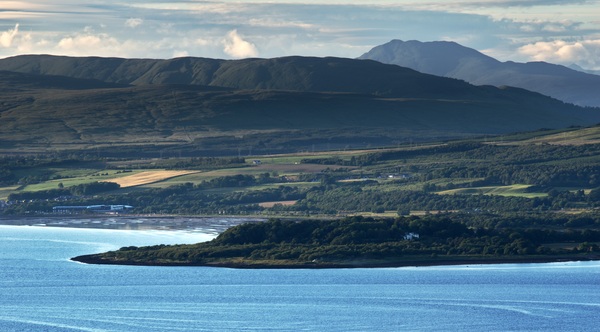
Trendy stores, a booming cultural life, fascinating architecture, and stylish restaurants reinforce Glasgow's claim to being Scotland's most exciting city. After decades of decline, it has experienced an urban renaissance uniquely its own. The city’s grand architecture reflects a prosperous past built on trade and shipbuilding. Today buildings by Charles Rennie Mackintosh hold pride of place along with the Zaha Hadid–designed Riverside Museum.Glasgow (the "dear green place," as it was known) was founded some 1,500 years ago. Legend has it that the king of Strathclyde, irate about his wife's in... See moreTrendy stores, a booming cultural life, fascinating architecture, and stylish restaurants reinforce Glasgow's claim to being Scotland's most exciting city. After decades of decline, it has experienced an urban renaissance uniquely its own. The city’s grand architecture reflects a prosperous past built on trade and shipbuilding. Today buildings by Charles Rennie Mackintosh hold pride of place along with the Zaha Hadid–designed Riverside Museum.Glasgow (the "dear green place," as it was known) was founded some 1,500 years ago. Legend has it that the king of Strathclyde, irate about his wife's infidelity, had a ring he had given her thrown into the river Clyde. (Apparently she had passed it on to an admirer.) When the king demanded to know where the ring had gone, the distraught queen asked the advice of her confessor, St. Mungo. He suggested fishing for it—and the first salmon to emerge had the ring in its mouth. The moment is commemorated on the city's coat of arms.The medieval city expanded when it was given a royal license to trade; the current High Street was the main thoroughfare at the time. The vast profits from American cotton and tobacco built the grand mansions of the Merchant City in the 18th century. In the 19th century the river Clyde became the center of a vibrant shipbuilding industry, fed by the city’s iron and steel works. The city grew again, but its internal divisions grew at the same time. The West End harbored the elegant homes of the newly rich shipyard owners. Down by the river, areas like the infamous Gorbals, with its crowded slums, sheltered the laborers who built the ships. They came from the Highlands, expelled to make way for sheep, or from Ireland, where the potato famines drove thousands from their homes.During the 19th century the population grew from 80,000 to more than a million. And the new prosperity gave Glasgow its grand neoclassical buildings, such as those built by Alexander "Greek" Thomson, as well as the adventurous visionary buildings designed by Charles Rennie Mackintosh and others who produced Glasgow’s Arts and Crafts movement. The City Chambers, built in 1888, are a proud statement in marble and gold sandstone, a clear symbol of the wealthy and powerful Victorian industrialists' hopes for the future.The decline of shipbuilding and the closure of the factories led to much speculation as to what direction the city would take now. The curious thing is that, at least in part, the past gave the city a new lease of life. It was as if people looked at their city and saw Glasgow’s beauty for the first time: its extraordinarily rich architectural heritage, its leafy parks, its artistic heritage, and its complex social history. Today Glasgow is a vibrant cultural center and a commercial hub, as well as a launching pad from which to explore the rest of Scotland, which, as it turns out, is not so far away. In fact, it takes only 40 minutes to reach Loch Lomond, where the other Scotland begins.
See less -
Day 14 Greenock, Scotland 18 Aug 2026 (Tuesday)
Trendy stores, a booming cultural life, fascinating architecture, and stylish restaurants reinforce Glasgow's claim to being Scotland's most exciting city. After decades of decline, it has experienced an urban renaissance uniquely its own. The city’s grand architecture reflects a prosperous past built on trade and shipbuilding. Today buildings by Charles Rennie Mackintosh hold pride of place along with the Zaha Hadid–designed Riverside Museum.Glasgow (the "dear green place," as it was known) was founded some 1,500 years ago. Legend has it that the king of Strathclyde, irate about his wife's in... See moreTrendy stores, a booming cultural life, fascinating architecture, and stylish restaurants reinforce Glasgow's claim to being Scotland's most exciting city. After decades of decline, it has experienced an urban renaissance uniquely its own. The city’s grand architecture reflects a prosperous past built on trade and shipbuilding. Today buildings by Charles Rennie Mackintosh hold pride of place along with the Zaha Hadid–designed Riverside Museum.Glasgow (the "dear green place," as it was known) was founded some 1,500 years ago. Legend has it that the king of Strathclyde, irate about his wife's infidelity, had a ring he had given her thrown into the river Clyde. (Apparently she had passed it on to an admirer.) When the king demanded to know where the ring had gone, the distraught queen asked the advice of her confessor, St. Mungo. He suggested fishing for it—and the first salmon to emerge had the ring in its mouth. The moment is commemorated on the city's coat of arms.The medieval city expanded when it was given a royal license to trade; the current High Street was the main thoroughfare at the time. The vast profits from American cotton and tobacco built the grand mansions of the Merchant City in the 18th century. In the 19th century the river Clyde became the center of a vibrant shipbuilding industry, fed by the city’s iron and steel works. The city grew again, but its internal divisions grew at the same time. The West End harbored the elegant homes of the newly rich shipyard owners. Down by the river, areas like the infamous Gorbals, with its crowded slums, sheltered the laborers who built the ships. They came from the Highlands, expelled to make way for sheep, or from Ireland, where the potato famines drove thousands from their homes.During the 19th century the population grew from 80,000 to more than a million. And the new prosperity gave Glasgow its grand neoclassical buildings, such as those built by Alexander "Greek" Thomson, as well as the adventurous visionary buildings designed by Charles Rennie Mackintosh and others who produced Glasgow’s Arts and Crafts movement. The City Chambers, built in 1888, are a proud statement in marble and gold sandstone, a clear symbol of the wealthy and powerful Victorian industrialists' hopes for the future.The decline of shipbuilding and the closure of the factories led to much speculation as to what direction the city would take now. The curious thing is that, at least in part, the past gave the city a new lease of life. It was as if people looked at their city and saw Glasgow’s beauty for the first time: its extraordinarily rich architectural heritage, its leafy parks, its artistic heritage, and its complex social history. Today Glasgow is a vibrant cultural center and a commercial hub, as well as a launching pad from which to explore the rest of Scotland, which, as it turns out, is not so far away. In fact, it takes only 40 minutes to reach Loch Lomond, where the other Scotland begins.
See less -
Day 15 Cobh, Ireland 19 Aug 2026 (Wednesday)
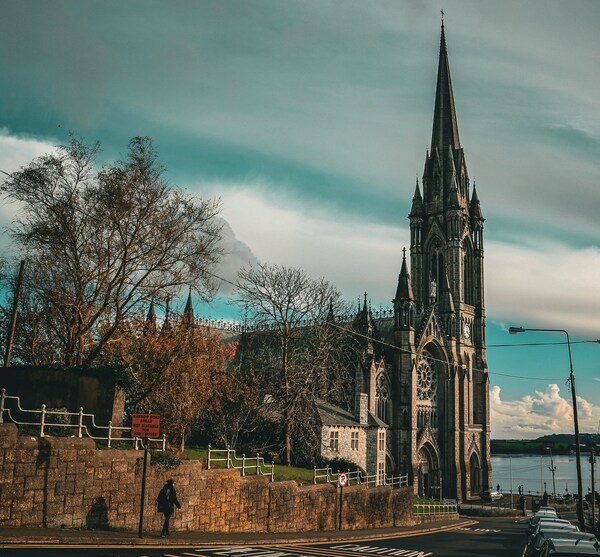
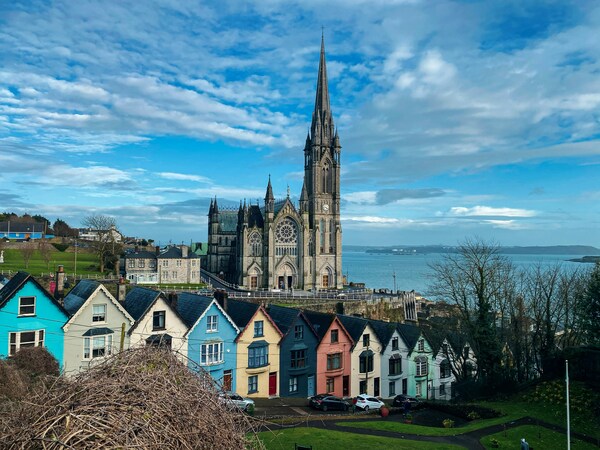
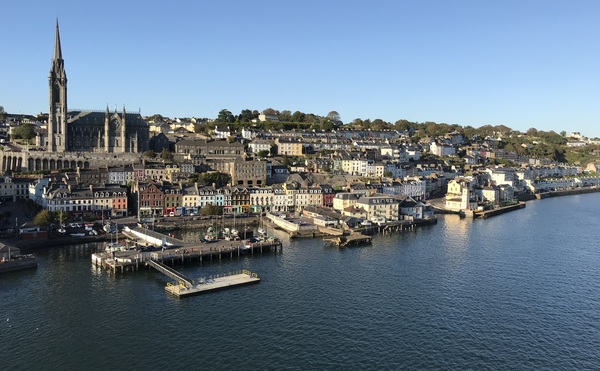
Cork City's nearby harbor district has seen plenty of history. Cork Harbour's draws include Fota Island—with an arboretum, a wildlife park, and the Fota House ancestral estate—and the fishing port of Cobh.Cork City's nearby harbor district has seen plenty of history. Cork Harbour's draws include Fota Island—with an arboretum, a wildlife park, and the Fota House ancestral estate—and the fishing port of Cobh.
See less -
Day 17 Southampton, England 21 Aug 2026 (Friday)
Lying near the head of Southampton Water, a peninsula between the estuaries of the Rivers Test and Itchen, Southampton is Britain’s largest cruise port. It has been one of England’s major ports since the Middle Ages, when it exported wool and hides from the hinterland and imported wine from Bordeaux. The city suffered heavy damage during World War Two and as a result the centre has been extensively rebuilt, but there are still some interesting medieval buildings including the Bargate, one of the finest city gatehouses in England.Lying near the head of Southampton Water, a peninsula between the estuaries of the Rivers Test and Itchen, Southampton is Britain’s largest cruise port. It has been one of England’s major ports since the Middle Ages, when it exported wool and hides from the hinterland and imported wine from Bordeaux. The city suffered heavy damage during World War Two and as a result the centre has been extensively rebuilt, but there are still some interesting medieval buildings including the Bargate, one of the finest city gatehouses in England.
See less
What's Included:
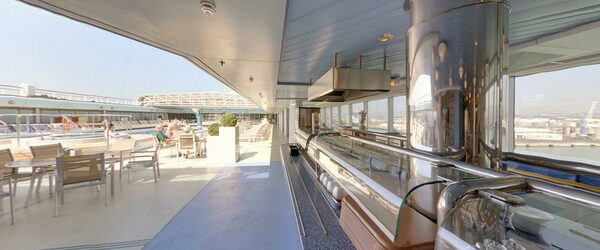
- Full-board dining across a variety of restaurants.
- Entertainment options, including West End-style shows and live music.
- Access to pools, gyms, and other leisure facilities.
- Children's clubs catering to different age groups.
- Prices in pounds sterling on board for added convenience.
Suites
-
Inside Single Cabins
Enjoy the perfect hideaway in a Single Inside cabin. There's a wardrobe and plenty of drawer space for all your outfits. You have your own TV and toiletries from The White Company. Some Single cabins may have a table and chairs or even a sofa for relaxing in private.
Inside Single Cabins
-
Single Balcony Cabins
Step into your private outdoor space for some fresh air whenever you like. If you like to feel the sea breeze and enjoy having your own private outdoor space, a Balcony cabin is ideal. Your balcony is the perfect place to savour a lazy continental breakfast or spend a few peaceful hours sunbathing with a book.
Your own private balcony is the ideal place to enjoy your morning cuppa or a quiet moment when the mood takes you. There's a choice of balcony furniture, as well as your own table, chairs, sofa and TV inside for a relaxing home- from- home feel. Beds convert to twin or king size.
Balcony cabins have the following benefits
- Air conditioning
- Tea and coffee facilities
- Free in-cabin TV
- Daily steward service
- Cabin safe
- Cabin hairdryer
- Cabin telephone
- Vanity writing desk and chair
- Toiletries from The White Company
- British plug socket
- Chiller
- Floor to ceiling glass doors

- Balcony
Single Balcony Cabins
-
Inside Cabin
A practical and pocket-friendly choice if you simply need a comfy place to lay your head each night and know that your days will be spent enjoying everything that your ship has to offer.
Cosy and comfortable, an Inside cabin is just the place to relax and re-energise for all your holiday adventures on board and ashore. You'll have your own TV, toiletries from The White Company and (on some ships) these cabins even come with a sofa and / or table and chairs.
Inside cabin has the following benefits
- Air conditioning
- Tea and coffee facilities
- Free in-cabin TV
- Daily steward service
- Cabin safe
- Cabin hairdryer
- Cabin telephone
- Vanity writing desk and chair
- Toiletries from The White Company
- British plug socket
- Chiller
Inside Cabin
-
Sea View Cabins (Obstructed View)
If natural light and a view are a must, our Sea view cabins ensure you’re never too far away from those relaxing views! Each one offers a similar layout and features of an Inside cabin, but with the addition of a window or porthole. You’ll enjoy natural light in your cabin although the view will be obstructed, for example by a lifeboat.
Sea view cabins have the following benefits
- Air conditioning
- Tea and coffee facilities
- Free in-cabin TV
- Daily steward service
- Cabin safe
- Cabin hairdryer
- Cabin telephone
- Vanity writing desk and chair
- Toiletries from The White Company
- British plug socket
- Chiller
- Window/porthole
Sea View Cabins (Obstructed View)
-
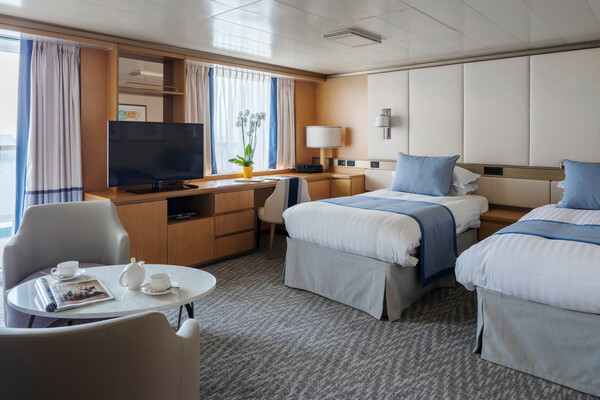
Sea View Cabins
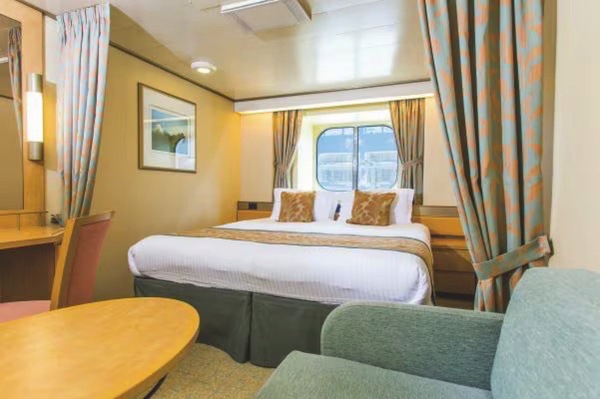
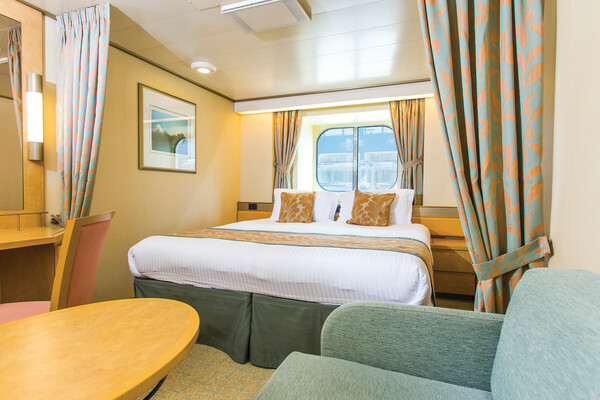
Relax in a comfy cabin with a porthole or window on the world to bring the outside in. Your room with a view includes a sofa and / or table and chairs, with beds that convert from twin to king size. You also have your own TV and The White Company toiletries.
If natural light and a view are a must, our Sea view cabins ensure you’re never too far away from those relaxing views! Each one offers a similar layout and features of an Inside cabin, but with the addition of a window or porthole. You’ll enjoy natural light in your cabin although the view will be obstructed, for example by a lifeboat.Sea view cabins have the following benefits
- Air conditioning
- Tea and coffee facilities
- Free in-cabin TV
- Daily steward service
- Cabin safe
- Cabin hairdryer
- Cabin telephone
- Vanity writing desk and chair
- Toiletries from The White Company
- British plug socket
- Chiller
- Window/porthole
Sea View Cabins
-
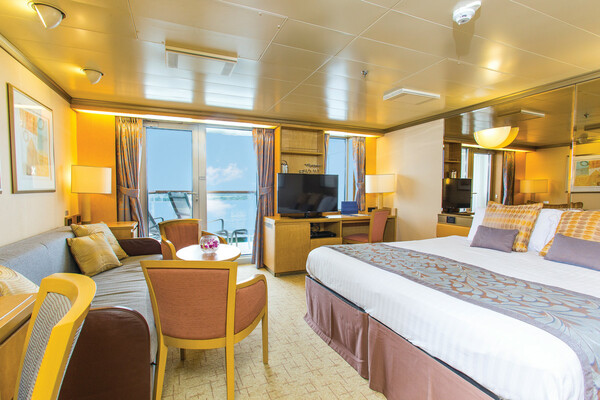
Deluxe Balcony Cabins
Your own private balcony is the ideal place to enjoy your morning cuppa or a quiet moment when the mood takes you. There's a choice of balcony furniture, as well as your own table, chairs, sofa and TV inside for a relaxing home- from- home feel. Beds convert to twin or king size.
A bigger balcony needs bigger windows for enjoying a great view. Your Deluxe Balcony cabin has floor-to-ceiling glass doors, extra space and a comfy sofa for relaxing. We'll also provide fluffy bath robes and slippers to add a touch of class.
Balcony cabin has the following benefits
- Air conditioning
- Tea and coffee facilities
- Free in-cabin TV
- Daily steward service
- Cabin safe
- Cabin hairdryer
- Cabin telephone
- Vanity writing desk and chair
- Toiletries from The White Company
- British plug socket
- Chiller
- Floor to ceiling glass doors
- Balcony
Deluxe Balcony Cabins
-
Mini-Suites
Like the sound of a Suite but don’t think you’d need all of the features? A Mini-suite is the perfect option. Sink into a full-size whirlpool bath* and take your pick of the luxurious premier toiletries. Pop open some Champagne, or savour a fresh cup of coffee from your own machine*. When you're ready to kick back after a day of exploring, you've a spacious lounge area to relax in.
A Mini-suite is a premium private space, offering more light and roomy relaxation in a spacious lounge. Enjoy luxuries like a whirlpool bath*, your own coffee machine and your own sound system*. *Some exceptions apply
Mini Suite has the following benefits:
- Air conditioning
- Tea and coffee machine
- Free in-cabin TV
- Butler service
- Cabin safe
- Cabin hairdryer
- Cabin telephone
- Larger dressing area
- Toiletries from The White Company
- British plug socket
- Chiller
- A whirpool bath
- Inclusive room service
- Exclusive restaurants
- Bathrobe and Slippers
- Canapés on celebration night
- Champagne on arrival
- Chocolates on arrival
- Floor to ceiling glass doors
- Balcony
- Priority check-in and boarding (from Southampton)
Mini-Suites
-
Suite
Delight in VIP treatment throughout your holiday with butler service, spacious accommodation, a superior bathroom with full-size whirlpool bath*, inclusive room service, breakfast each day in an exclusive restaurant plus all the luxuries included with Mini-suites.
The luxuries of a Suite include a whirlpool bath, dual sinks, dressing area and toiletries from The White Company. With an exclusive restaurant for breakfast and a dedicated butler, not to mention Champagne and chocolates on arrival, it’s a holiday like never before.*Some exceptions applySuite has the following benefits:
- Air conditioning
- Tea and coffee machine
- Free in-cabin TV
- Butler service
- Cabin safe
- Cabin hairdryer
- Cabin telephone
- Larger dressing area
- Toiletries from The White Company
- British plug socket
- Chiller
- A whirpool bath
- Inclusive room service
- Exclusive restaurants
- Bathrobe and Slippers
- Canapés on celebration night
- Champagne on arrival
- Chocolates on arrival
- Floor to ceiling glass doors
- Balcony
- Priority check-in and boarding (from Southampton)
Suite
Restaurants
-
Neptune Grill
This casual eatery offers a tempting selection of freshly made snacks, perfect for satisfying poolside cravings. Bite into juicy burgers or customise your hot dog with various toppings. Featuring flavours of the day that change throughout your cruise, the Poolside Grill uses fresh ingredients to ensure a delicious and convenient bite.
Dress code
Day / Evening Casual
-
Belvedere Buffet
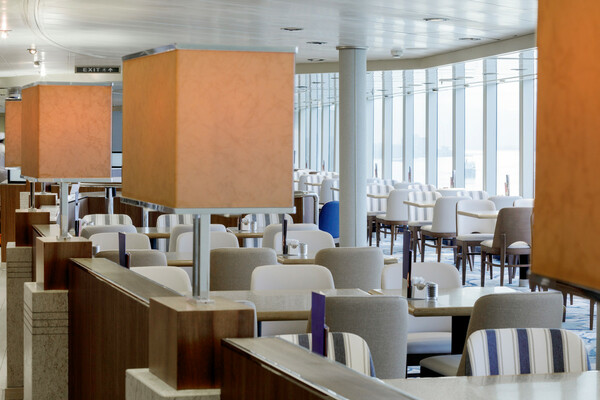
The buffet is your one-stop shop for casual dining at sea, offering an extensive international menu to satisfy every craving. You'll find the Horizon Buffet on Arvia, Aurora, Britannia and Iona, and the Belvedere Buffet on Arcadia. Azura boasts the Verona and Venezia buffets, while Ventura features the Waterside Buffet.
Dress code
Evening Casual. Tailored shorts are accepted.
-
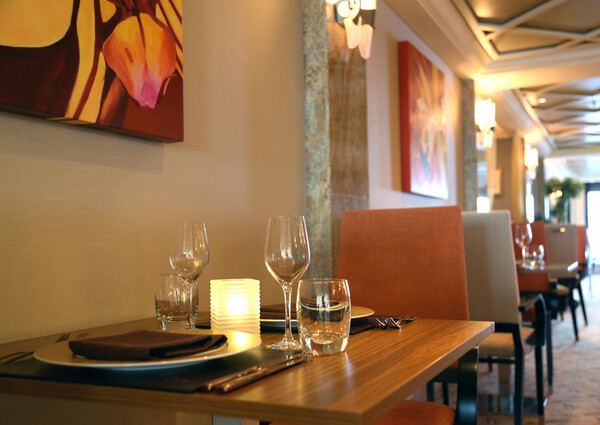
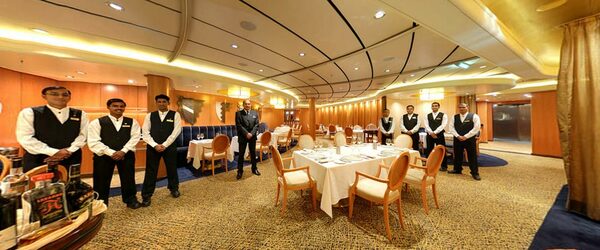
Meridian Restaurant
Experience a global culinary adventure of the highest quality at Medina. This opulent Arabian-themed space offers Freedom Dining flexibility, allowing you to dine whenever and with whomever you wish. From classic home comfort dishes to locally inspired flavours, the menus offer a delightful array of options that will leave you craving more.
Dress code
Dress code of the day (Evening Casual or Black Tie). No tailored shorts.
-
Sindhu Restaurant
Prepare your taste buds for a flavour-filled adventure. In stylish and sumptuous surroundings, Sindhu’s expert chefs will take you on a delicately spiced odyssey that celebrates the best of contemporary Indian cuisines. You can also make a date on selected sea days to enjoy a delicious tiffin style lunch.
Dress code
Dress code of the day (Evening Casual or Black Tie)
-
The Ocean Grill
Experience culinary excellence at Marco Pierre White's Ocean Grill, where attention to detail and quality reign supreme. Indulge in mouth-watering steaks and seafood in relaxed and sophisticated surroundings that mirror the spirit of great London grill restaurants. Simplicity meets artistry in masterfully presented dishes, delivering exceptional flavours that showcase Marco's expertise.
Dress code
Dress code of the day (Evening Casual or Black Tie)
-
Caffé Vivo
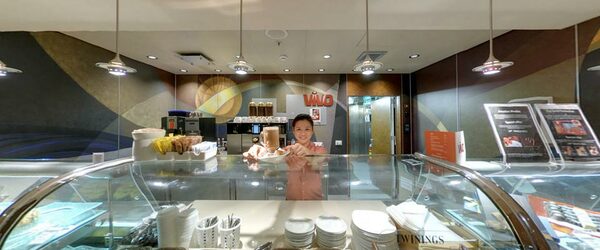
The perfect place to relax, indulge and people-watch, Caffè Vivo exudes warmth and Mediterranean charm with its brown leather sofas, high tables and wooden floors. It offers a cosy retreat just steps away from the on-board shops, so you can unwind as you sip aromatic coffee or a refreshing juice, or choose from a menu of light bites like salads, bagels and pastries.
Dress code - Casual
-
Room Service
Morning, noon, and through the night, if you fancy a bite to eat in your cabin, you've a mouthwatering room service menu to choose from.. meals, desserts, snacks and drinks, all prepared with care and delivered with a smile. A small supplement applies to each item, apart from breakfast, which is included in the price of your holiday.
-
Afternoon Tea
Served once a week on sea days, Arcadia's afternoon tea is a classic British treat included in your holiday price. Nibble through freshly made finger sandwiches, patisseries, and oven-warm scones with unlimited tea in Meridian Restaurant. Go fancier still with paid Afternoon Tea at Marco Pierre White's Ocean Grill. Or indulge in a little of what you fancy, helping yourself to the complimentary afternoon tea buffet at Belvedere Restaurant.
Deckplans
-
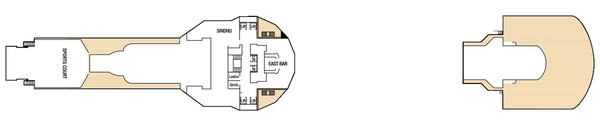
Deck 11 - Sky Deck
- Sports Court
- Sindhu
- East Bar
- Sports Court
-
Deck 10 - Sun Deck
- The Crow's Nest
- Retractable Roof
- The Retreat
- Viceroy Room/Wedding Venue
- Mini-Suites
- Deluxe Balcony Cabins
- Single Balcony Cabins
- Single Inside Cabins
- Inside Cabins
- The Crow's Nest
-
Deck 9 - Lido Deck
- Gym
- Treatment Rooms
- Oasis Spa & Salon
- Hydro Pool
- Steam Rooms
- Sauna
- Salon
- Neptune Pool
- Neptune Bar
- Neptune Grill
- The Belvedere
- Aquarius Pool
- Aquarius Bar
- Gym
-
Deck 8 - A Deck
- Suites
- Deluxe Balcony Cabins
- Inside Cabins
-
Deck 7 - B Deck
- Suites
- Mini-Suites
- Deluxe Balcony Cabins
- Inside Cabins
- Suites
-
Deck 6 - C Deck
- Suites
- Deluxe Balcony Cabins
- Outside Cabins
- Inside Cabins
- Suites
-
Deck 5 - D Deck
- Suites
- Mini-Suites
- Deluxe Balcony Cabins
- Inside Cabins
- Suites
-
Deck 4 - E Deck
- Suites
- Deluxe Balcony Cabins
- Outside Cabins
- Inside Cabin
-
Deck 3 - Prom Deck
- The Palladium
- Shopping
- Horizon
- The Screening Room
- Caffé Vivo
- Library
- The Piano Bar
- Meridian Restaurant
- The Palladium
-
Deck 2 - F Deck
- The Palladium
- Monte Carlo Casino
- The Rising Sun
- The Globe
- Art Gallery
- Ocean Grill
- Intermezzo
- Spinnaker Bar
- Meridian Restaurant
- The Palladium
-
Deck 1 - G Deck
- The Palladium
- Reception
- Tours Office
- Atrium
- Loyalty And Cruise Sales
- Outside Cabins
- Inside Cabins
- The Palladium
Ready to Book?
For more information; please contact our Cruise specialists who will be delighted to help you plan your next holiday.
Call us on 01625 858158 Request Availability & PriceSign up to our Newsletter for exclusive offers and receive up to £250 off your next holiday.
For New Subscribers Only.